


Overview of Official Land Prices for 2026
Rising for five consecutive years on average nationwide
Official Land Prices are determined and published annually by the Land Appraisal Committee of the Ministry of Land, Infrastructure, Transport and Tourism, in accordance with the Public Notice of Land Prices Act. The goal is to contribute to the formation of appropriate land prices by indicating the standard price per square meter of benchmark sites as of January 1 each year.
In the 2026 Official Land Price Survey, the national average increased for the fifth consecutive year across following uses (“overall-use average”, “residential”, and “commercial”). The rate of increase expanded for “overall” and “commercial” land, while “residential” land remained at the same level as the previous year. Nationwide, “overall” prices rose by 2.8% year-on-year (2.7% in the previous year), “commercial” land by 4.3% (3.9%), and “residential” land by 2.1% (unchanged).
In the three major metropolitan areas, prices also increased for the fifth consecutive year across all uses, with accelerating growth. “Overall” prices rose 4.6% (4.3% previously), “commercial” land 7.8% (7.1%), and “residential” land 3.5% (3.3%).
While the Tokyo and Osaka metropolitan areas saw expanded growth, the Nagoya area experienced a slowdown in all categories.
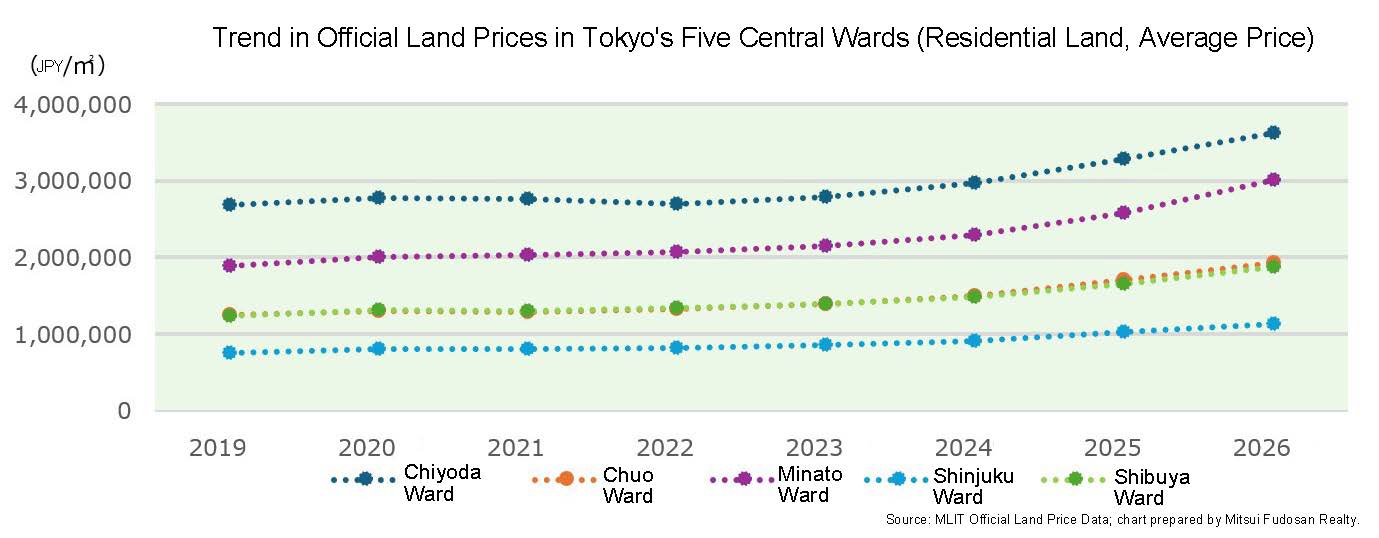
In the Tokyo metropolitan area (Tokyo and three surrounding prefectures), “overall” prices rose 5.7% and “residential” land rose 4.5%, exceeding the previous year’s 4.2%. In Tokyo’s 23 wards in particular, increases were notable; for example, land in Ginza 4-chome, Chuo Ward reached 67.1 million yen per square meter, up 10.9% year-on-year. Some locations in Minato, Bunkyo, and Taito wards recorded increases of over 20%. Strong housing demand and robust condominium demand in central urban areas continue to drive price growth.
In regional areas, prices increased for the fifth consecutive year across all uses, though the rate slowed for overall and “residential” land while “commercial” land remained unchanged. In the four major regional cities (Sapporo, Sendai, Hiroshima, and Fukuoka), growth slowed across all uses.
In other regions, “overall” and “residential” land maintained the same rate of increase, while “commercial” land saw accelerated growth.
However, land prices continue to decline in rural and mountainous areas experiencing population decline, such as parts of northern Kanto, Tohoku, and the San’in region. This highlights a growing polarization between convenient urban areas and regions facing declining demand.
Changes in Industrial Structure and Rising Land Prices
Looking at the locations where land prices are rising across the nation by land-use category, there is a growing number of cases in which, in addition to housing demand, changes in industrial structure are increasingly contributing to land price increases.
For example, Chitose City in Hokkaido, where a next-generation semiconductor plant is being developed, recorded the highest increase in commercial land prices nationwide, rising 44.1% year-on-year. In areas surrounding Kikuyo and Ozu towns in Kumamoto Prefecture, where TSMC-related investments are underway, land prices have risen not only for industrial land but also for residential and commercial areas. Regions hosting major semiconductor plants continue to see strong demand for housing, office space, hotels, and retail, supporting sustained price increases across all land types.
The recovery of inbound tourism has also driven land price increases in tourist areas, especially for commercial land. Areas around Asakusa in Taito Ward saw increases over 20%. Snow resort regions such as Hakuba in Nagano and Kutchan (including Niseko) in Hokkaido also experienced rising demand from investors, with residential land in Hokujo, Hakuba Village increasing by 33% and commercial land by 35.2%.
Furthermore, the expansion of e-commerce has driven demand for large-scale logistics facilities, boosting land prices around highway interchanges where labor is readily available. Industrial land in such areas continues to see increases of around 5%, exceeding the national average.
In recent years, demand for data center locations driven by foreign capital has also increased, and industrial uses are expected to have an even greater impact on land prices in the future.
*1 Source: Toyo Keizai Inc. [2026 Edition] Ranking of 'Residential Areas in Tokyo' with the Most Expensive Land
https://toyokeizai.net/articles/-/939455
*2 Source: "Overview of the 2026 Public Notice of Land Prices," Ministry of Land, Infrastructure, Transport and Tourism, announced March 17, 2026
*3 Source: Nihon Keizai Shimbun article (March 17, 2026)












お問い合わせ Contact us
まずは、お気軽にご相談ください。
お電話でのお問い合わせ
Webでのお問い合わせ
